The History of Old Colorado City: From Frontier Settlement to Historic Westside District
Before Old Colorado City became known for its locally owned shops, restaurants, galleries, and historic architecture, it was an independent frontier town with an identity entirely its own. Its history includes Indigenous heritage, westward expansion, territorial politics, mining, railroads, economic change, and community-led preservation.
Today, Old Colorado City is part of Colorado Springs, but its distinctive character reflects more than 165 years of local history.
The Land Before Colorado City
The history of the region did not begin with the establishment of Colorado City in 1859. Long before permanent European American settlement, the land surrounding present-day Colorado Springs was connected to numerous Indigenous peoples.
The Ute people have the longest continuous relationship with the region. The Cheyenne, Arapaho, and other Native nations also traveled, hunted, traded, and established cultural connections throughout the Pikes Peak area. Ute Pass served as an important route through the mountains long before settlers used it to reach mining communities farther west.
Recognizing this earlier history provides a more complete understanding of Old Colorado City. Its location was valuable not simply because settlers discovered it, but because it was already part of an established landscape of travel, trade, and cultural significance.
Colorado City Is Established in 1859
Colorado City was formally organized in August 1859 during the Pikes Peak Gold Rush. Founders Melancthon Beach, Anthony Bott, George Bute, and Rufus Cable envisioned a settlement that could supply prospectors traveling through Ute Pass to mining areas in the mountains.
The town was positioned near Fountain Creek and the eastern entrance to the pass. Freighters, merchants, ranchers, farmers, and other entrepreneurs began establishing homes and businesses there. By the winter of 1859–1860, approximately 100 log cabins had reportedly been constructed.
However, Colorado City did not immediately become the large commercial center its founders imagined. Mining routes shifted, other settlements attracted more travelers, and the local population declined during portions of the 1860s.
Even so, the town had already secured an important place in the development of the Pikes Peak region.
Was Old Colorado City Once Colorado’s Capital?
Colorado City is frequently described as Colorado’s first territorial capital. That statement is generally accurate, although the full story is more complicated.
Colorado City was selected as the capital of the newly formed Colorado Territory in 1861. When the territorial legislature gathered there in July 1862, lawmakers reportedly found the available accommodations unsuitable. After meeting for only a few days, they adjourned and reconvened in Denver. Golden was subsequently selected as the territorial capital.
Therefore, Colorado City held the designation briefly and hosted only a short portion of one legislative session. Although its period as a capital was limited, the episode reflects the town’s early political importance and the rapid competition among Colorado’s developing communities.
Colorado City also served as the El Paso County seat until 1873, when that role moved to the growing community of Colorado Springs.
The Arrival of Colorado Springs
General William Jackson Palmer founded Colorado Springs east of Colorado City in 1871. The two communities developed with noticeably different identities.
Colorado Springs was promoted as an orderly resort destination and initially maintained strict restrictions on alcohol. Colorado City developed as a working-class commercial and industrial community. It served railroad employees, mill workers, miners, freighters, and travelers moving between the plains and the mountains.
Historical accounts often emphasize Colorado City’s saloons, gambling establishments, and brothels. These businesses were part of the town’s past, particularly around the commercial corridor. However, focusing exclusively on them can create an incomplete picture.
Colorado City was also home to families, churches, schools, neighborhood businesses, civic organizations, and a Carnegie library. Residents repeatedly worked to regulate vice-related businesses and improve the town’s reputation. Its history was shaped by both entertainment establishments and the people building an ordinary, functioning community around them.
Railroads, Mining, and Industrial Growth
The arrival of the Colorado Midland Railway during the 1880s helped transform Colorado City. The railroad established major operations in the area, creating jobs and connecting the community to mountain mining districts and regional markets.
The discovery of gold near Cripple Creek in 1891 created another period of significant growth. Although much of the ore was extracted elsewhere, Colorado City became an important processing center. Large reduction mills treated ore transported from the mining district, while railroad facilities moved workers, equipment, supplies, and materials throughout the region.
This industrial economy supported more than mining alone. Local residents worked in rail yards, mills, factories, stores, hotels, restaurants, offices, and service businesses. Other industries included glass production, ironworks, and paint manufacturing.
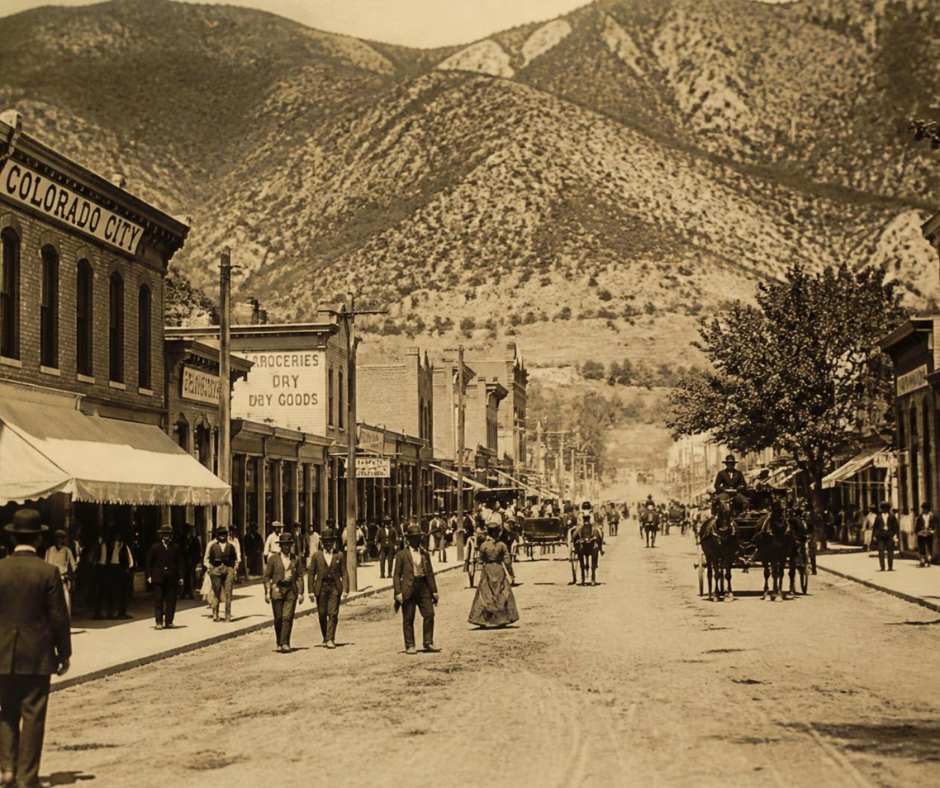
During this period, the commercial blocks along Colorado Avenue developed many of the brick buildings that now help define the appearance of Old Colorado City.
Labor and Working-Class History
Colorado City’s industrial growth also produced difficult working conditions and labor disputes. Mill and railroad employees often faced long hours, dangerous environments, and economic uncertainty.
In the early 1900s, labor conflicts connected to the Western Federation of Miners affected Colorado City and other mining communities across the state. These disputes reflected larger national disagreements over wages, working conditions, unions, and the power of industrial employers.
This working-class history remains an important part of Old Colorado City’s identity. The neighborhood was shaped not only by prominent founders and business owners, but also by the labor of miners, mill workers, railroad employees, tradespeople, and their families.
Annexation by Colorado Springs
By the early 20th century, Colorado City’s economic position had begun to change. Mining activity declined, railroad operations shifted, and the local industrial base weakened.
Residents debated whether annexation by Colorado Springs would provide more reliable municipal services and greater financial stability. After an earlier proposal failed, voters approved annexation, and Colorado City officially became part of Colorado Springs in 1917.
The annexation ended Colorado City’s existence as an independent municipality. For many years, the area was commonly known as the Westside or West Colorado Springs.
Its original street pattern, historic buildings, and neighborhood identity nevertheless remained visible.
Preservation and the Return of “Old Colorado City”
By the middle of the 20th century, changing transportation patterns and suburban development had affected older commercial districts across the United States. Colorado Avenue experienced similar economic challenges.
Beginning in the 1970s, residents, property owners, business leaders, and preservation advocates worked to restore the historic commercial area. Building façades were repaired, architectural details were uncovered, utility lines were relocated, and the district was promoted under the name Old Colorado City.
In 1982, the Old Colorado City Historic Commercial District was added to the National Register of Historic Places. The designated area includes historic commercial properties primarily located along West Colorado Avenue between 24th and 27th streets.
The district contains examples of Western Victorian commercial architecture, including features associated with Queen Anne, Italianate, and Romanesque Revival design. Bancroft Park, the historic cabin, and surrounding civic buildings further connect the modern neighborhood to its early development.
Old Colorado City Today
Today, Old Colorado City is one of the most recognizable historic neighborhoods in Colorado Springs. Its commercial district includes restaurants, boutiques, galleries, professional services, and locally owned businesses. Community events bring residents and visitors to West Colorado Avenue throughout the year.
The surrounding Westside contains a mixture of historic houses, apartments, renovated buildings, and newer development. Its location between downtown Colorado Springs and Manitou Springs also makes it a popular area for people who value access to local businesses, outdoor recreation, and historic surroundings.
Like many desirable historic districts, Old Colorado City continues to face questions involving growth, housing affordability, traffic, preservation, tourism, and neighborhood change. Its story is still developing, and decisions made today will influence how its historic character is experienced in the future.
Why Old Colorado City’s History Matters
Old Colorado City represents several major chapters in the history of Colorado Springs. Its story includes the region’s Indigenous heritage, the Pikes Peak Gold Rush, territorial government, railroad development, mining-related industry, organized labor, annexation, and historic preservation.
It is also a reminder that local history is rarely simple. Colorado City was simultaneously a commercial outpost, an industrial town, a family community, a center of entertainment, and a place affected by expansion onto Indigenous homelands. Understanding all of these elements creates a richer and more accurate picture of the neighborhood.
The historic buildings along West Colorado Avenue are more than an attractive backdrop. They represent generations of residents, workers, entrepreneurs, and community advocates who shaped one of the oldest and most distinctive areas in the Pikes Peak region.
Progressive Property Group is committed to compliance with the Fair Housing Act and all state and federal fair housing laws. We do business in accordance with equal housing opportunity